An open letter to the Seattle Parks Department:
The way the Seattle Parks Department works with volunteer advocates from the skateboarding community is currently broken. We believe the causes of the dysfunction are systemic and avoidable. Below are suggestions for how to improve the dynamic between SPR and the skateboarding community so that we can all work together respectfully and productively to deliver on the promise of the Seattle Citywide Skatepark Plan.
Background and Summary
In February 2006, the Seattle City Council adopted Resolution #30843, recognizing skateboarding as a healthy and popular recreational activity, and committing to establish a network of skateparks of various sizes throughout the City. At that time, Seattle Parks and Recreation (SPR) worked with an appointed Skatepark Advisory Task Force and a planning consultant to develop the Citywide Skatepark Plan. The Seattle Department of Transportation and the Port of Seattle were also represented on the Task Force.
During the planning process, citizens and public agencies nominated 130 sites for potential skateparks. A Task Force member and the consultant visited all 130 sites and calculated a score for each site based on weighted criteria. The top 30 sites were discussed with the community and SPR. The Task Force recommended 26 sites for inclusion in what is now known as the Seattle Citywide Skatepark Plan (Plan), published on January 31, 2007. The Plan included the following skatepark recommendations:
- 8 Skatedots
- 9 Skatespots
- 4 District Skateparks
- 1 Regional Skatepark
- 4 Potential Future Sites
Who are skatepark advocates?
Ken Bounds was the first Seattle Parks Superintendent to really get skateparks. We enjoyed working with Ken on several pivotal projects in Seattle’s storied skatepark history. In an article announcing his retirement, he said: “We’ve got our staff working very well with lots of partners, not the least of which are volunteers.” In the 2014 article, he also said that volunteers contributed around 300,000 hours of labor to the department last year, doing everything from planting trees to cutting down English ivy in greenbelts. Volunteers and advocates have always been an important part of Seattle Parks Department’s mission, but their role can fluctuate greatly from project to project, and SPR does not seem to have a formal set of policies or framework to direct staff when working with advocates.
Advocates are:
- Skateboarders
- Professionals
- Parents
- Taxpayers
- Concerned citizens
- Kids and adults
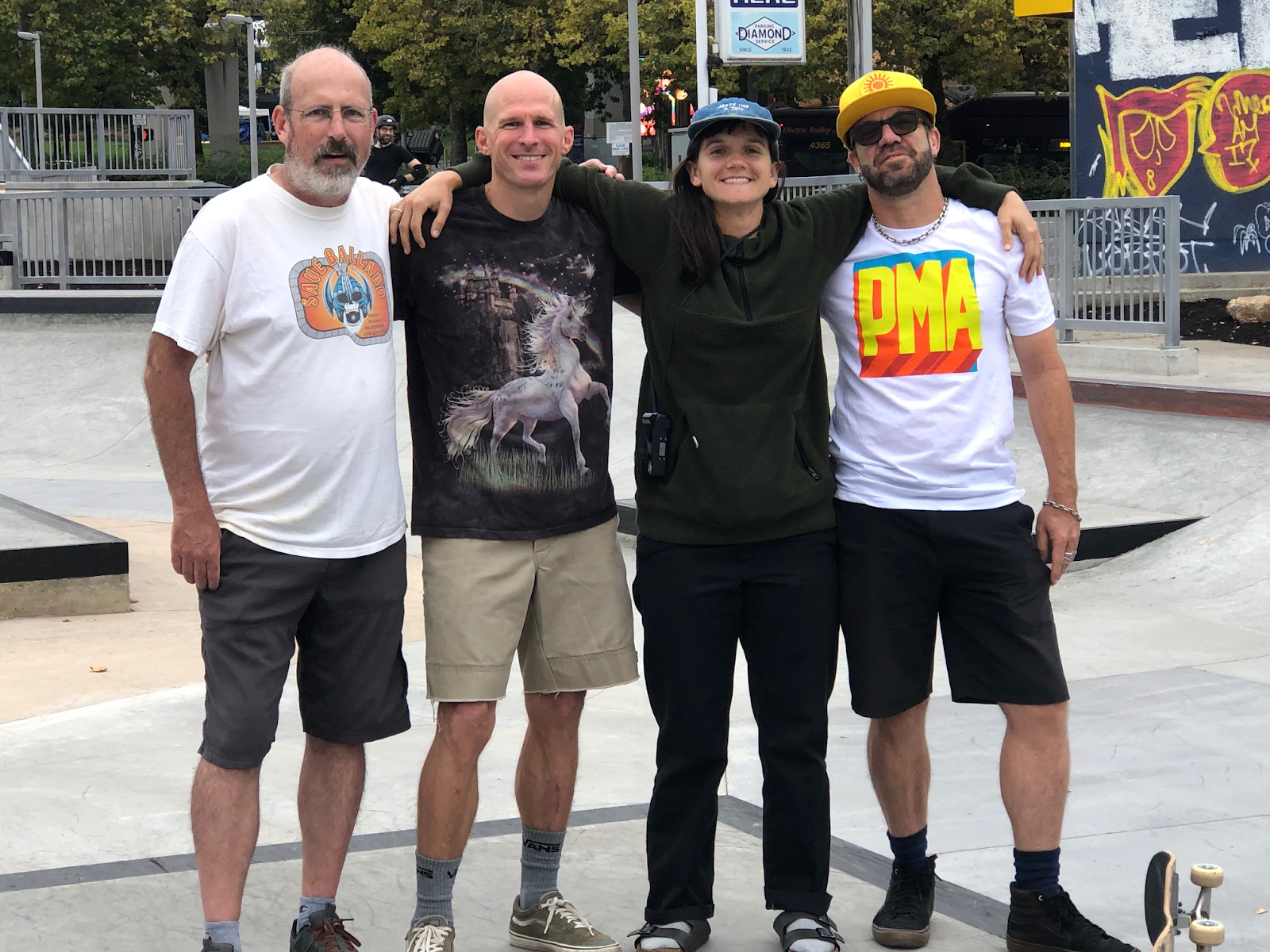
The current membership of the SPAC worked together on Seattle Center Skatepark 5.
Photo: Robert Nellams
Anatomy of an advocacy effort
Members of the Seattle Skatepark Advisory Committee (SPAC) have been advocating for safe and accessible public skateparks in Seattle since 2004. The first iteration of the SPAC was founded by SPR and the skateboarding community to support the successful implementation of Lower Woodland Skatepark, and later the Plan itself. Susan Golub served as the dedicated staff liaison to the SPAC, and its minutes were published on the SPR website. Three SPAC 1 members served on the Skatepark Advisory Task Force that authored the Plan and sanctioned 26 sites in Seattle for skateboarding. Each current SPAC advocate has personally donated thousands of volunteer hours in support of safe places in Seattle for people of all ages to enjoy a healthy activity and belong to an active community.
In our experience, the role of skatepark advocates in SPR projects is fluid and undefined. Each project varies and has different needs. The skatepark movement started our advocacy “careers” in Seattle because SPR wanted to demolish the Ballard Bowl. At the time, it was the only skatepark in the city and there was no plan to replace it. Our role as advocates was to shift policymaker perceptions that skateboarding was just a fad. Rather, it is a healthy and popular recreational activity requiring publicly-funded, dedicated facilities. Nationally, skateboarders were also organizing around skateparks and Seattle followed Portland as the second major US city with a citywide skatepark plan.
20 years later, the Pacific Northwest now has the highest density of skateparks per capita of any other region in the nation. This is largely due to the efforts of unpaid advocates, and because SPR was willing to meet the changing needs of stakeholders.
Today we are hoping to work with the same openness and willingness to evolve SPR institutional practices to better address Seattle’s current skatepark needs and define the roles and responsibilities of skatepark advocates to meet those needs.
Duties that volunteer advocates commonly perform on a Seattle Skatepark project:
- Identify skatepark needs in the community
- Attend and facilitate public meetings
- Establish and maintain communication with SPR
- Mobilize and document community support for Plan sites and other skateable public spaces
- Perform outreach to neighborhood councils, groups and businesses
- Set up and manage campaign websites
- Acquire fiscal sponsorship, write grants, track and account for project finances and volunteer matching hours
- Raise funds
- Coordinate volunteer teams, sometimes including over 50 people
- Oversee design and construction processes, including schematic review
- Act as subject matter experts in design, construction, and accessibility of skateparks
- Interview contractor and vendor candidates
- Craft, review, and deliver official messaging
- Represent projects at public events
- Work directly with Central Staff on policy language
- Speak to the press
- Write letters of support, or requesting support from city officials
- Organize site cleanups
- Solicit and gather community feedback
- Organize, staff and manage project information booths at public events
- Establish and manage “Friends of” groups for skatepark stewardship
Current challenges to skatepark advocates
- We need to evolve the role of advocates on SPR projects from proxy laborers to subject matter experts.
The relationship between advocates and SPR staff has felt increasingly adversarial over the last decade. We often have to hurdle walls of secrecy and pester SPR for inclusion at the table for discussions regarding projects that would not exist without our involvement. Current advocates have more experience, expertise, and institutional knowledge working on skatepark projects than some of the SPR staff managing these projects. Advocates should be treated as subject matter experts, making generous donations of time and expertise, with deep connections to the communities for whom SPR is building and maintaining these important public spaces. As illustrated in the following examples, we are being shut out of many critical processes managed by SPR where our involvement was previously solicited and valued.
Example: Recently, advocates were not allowed to attend a meeting with contractors paid by grant funds awarded to the advocates themselves. On another current project, advocates were denied access to design documents used for 90% Proview and SDCI permitting. Advocates often feel excluded and only spoken to on a need-to-know basis or when SPR has a problem that advocates can help them solve. Advocates are not commonly treated as valuable members of a team.
Suggestion: The critical role skatepark advocates play on projects should be formally acknowledged by SPR as subject matter experts for a specialty project, and they should be treated and respected as valued members of the team. We would like to understand why this dynamic has changed so drastically, and work collaboratively with SPR to bring valuable and crucial volunteer advocate voices back to the table.
- Advocate roles and responsibilities are not clearly defined or communicated to advocates or SPR staff.
Lacking a framework for working with advocates, SPR PMs are given wide flexibility and freedom to engage, or not engage, with advocates. This flexibility has manifested as a set of dysfunctional relationships where advocates feel used when it is convenient for SPR, but not respected and included as proper members of a team.
Example: On the Morgan Junction skatedot project, advocates and the design contractor were left to represent the project to the community at a street fair, with no SPR representatives on hand. All day, advocates dubiously engaged with community members, some of whom addressed them confrontationally, as if they were SPR staff. SPR also mailed a postcard to the community announcing the activation, misleading the community to think that it was an official SPR outreach effort. We understand and agree that SPR needs to do outreach on these projects, but in many cases sends volunteer advocates to the front lines. But when the same advocates want to attend a meeting or see updated design documents, it is deemed inappropriate by SPR. It is contradictory and exploitative to use advocates when it is convenient for SPR, but to not include them at the table as team members when important decisions are being made.
Suggestion: Work with the SPAC to create formal advocate roles and responsibilities and communicate them as enforceable practices to all SPR project staff.
- SPR communication protocols are unclear and current practices are problematic.
Communication among SPR staff and advocates is universally broken due to what feels like a culture of fear within the organization. It is very common for SPR staff to push all communications with advocates into isolated, unaccountable phone conversations. This feels like a “divide and conquer” technique, and advocates are often told to maintain confidentiality about these conversations. This practice breeds mistrust and resentment. Document sharing is equally problematic. In general, transparency is a problem, and it feels like there is a deliberate attempt to avoid accountability on the part of SPR staff.
Example: Advocates recently made a public disclosure request for the 90% construction documents for the Rainier Beach skatepark, as well as the 60% construction documents for its proposed roof. The purpose of the request was to verify final changes to skatepark terrain, and to keep the discarded roof design for future reference to other advocates. A policy of transparency would have avoided this situation and helped to build trust in the design process.
Suggestion: Increase clarity on disclosure policies for different types of project documentation, and who/when exemptions to public disclosure need to be made and for what reasons.
Recommendations:
- SPR should officially recognize the SPAC, and work with advocates to evolve and improve internal skatepark-related policies. The committee’s current charter is to ensure that the role of advocates is appreciated, respected, and nurtured on all projects, now and in the future. We are already doing this work. Members of the committee already provide support and resources for community advocates on all skatepark projects.
- SPR should adopt a new internal policy establishing advocates as required members of skatepark project teams. The policy would define advocate roles and responsibilities, and more importantly, establish a protocol for how advocates are to be managed and treated by SPR staff.
- Every skatepark project team should include at least one paid advocate position. Advocates would then be in a better position to do important work for the project, including community outreach.
- Every skatepark project should track volunteer time, using a common metric such as hourly rate. Volunteer time should be a factor when evaluating project costs, and be budgeted just like any other project cost.
- A post-mortem process should be created for each skatepark project that includes advocate feedback. Data gathered would include community surveys and a grade from the advisory committee on how well the project used advocate and community input to design and build the skatepark.
Thank you for your consideration,
Seattle Skatepark Advisory Committee
Matt Johnston
Kristin Ebeling
Scott Shinn
Ryan Barth
